Category: Use of Force Law & Legal Boundaries

  • Use of Force Policy and Accountability

    Use of Force Policy and Accountability

    Did you know that over 18,000 separate agencies oversee public safety in the United States? This massive number means rules can vary wildly from one town to another. Such a variety makes having a clear use of force policy and accountability system vital for every community.

    Clear law enforcement guidelines help build a strong bridge between officers plus the people they protect. When citizens understand the rules, trust grows naturally. These standards ensure safety remains the top priority during every single interaction between the public plus the police.

    Modern policing thrives when protocols are easy to understand, allowing officers to feel more confident when they have specific steps to follow in tough moments. Clear communication helps prevent mistakes plus keeps neighborhoods peaceful for everyone living there.

    Strong frameworks provide necessary tools for growth within any department. By focusing on transparency, agencies can improve their relationship with local residents. It is about creating a safe environment where justice plus respect work together.

    Key Takeaways

    • Defined rules increase public trust.
    • Consistency helps officers make better decisions.
    • Transparency reduces legal risks for agencies.
    • Clear standards improve community relations.
    • Training supports the proper application for rules.
    • Responsibility ensures justice for all parties.
    • Clear expectations benefit neighborhood safety.

    Understanding the Foundation of Use of Force Policies

    The foundation of use of force policies is rooted in a combination of legal, constitutional, and ethical considerations. These policies are designed to guide law enforcement officers in their interactions with the public, ensuring that the use of force is minimized and, when necessary, applied in a manner that is proportionate to the threat faced.

    Effective use of force policies is critical for maintaining police accountability measures and preventing instances of excessive force. By establishing clear guidelines and protocols, law enforcement agencies can reduce the risk of misconduct and promote a culture of transparency and accountability.

    Legal Framework and Constitutional Standards

    The legal framework governing the use of force by law enforcement is primarily based on the Fourth Amendment to the U.S. Constitution, which protects citizens from unreasonable searches and seizures. The Supreme Court has interpreted this amendment to require that the use of force be “objectively reasonable” under the circumstances.

    Law enforcement agencies must also comply with federal and state laws, as well as departmental policies, that regulate the use of force. These laws and policies provide a framework for officers to follow, ensuring that their actions are consistent with constitutional standards.

    Legal Standard Description Application
    Fourth Amendment Protects against unreasonable searches and seizures Requires “objectively reasonable” use of force
    Federal Laws Regulate law enforcement practices nationwide Sets minimum standards for use of force
    State Laws Provide additional regulations specific to each state May impose stricter standards than federal laws

    Defining Reasonable Force in Law Enforcement

    Defining reasonable force is a critical aspect of use of force policies. It involves assessing the level of force that is necessary to resolve a situation safely and effectively. Factors such as the severity of the crime, the level of threat posed by the suspect, and the availability of alternative methods are considered.

    Core Principles of Modern Policing Standards

    Modern policing standards emphasize the importance of de-escalation techniques, crisis intervention, and community policing. These principles are designed to reduce the need for force and promote positive relationships between law enforcement and the communities they serve.

    • De-escalation techniques to minimize confrontations
    • Crisis intervention training to handle mental health situations
    • Community policing to build trust and cooperation

    By understanding and implementing these core principles, law enforcement agencies can develop use of force policies that are both effective and respectful of citizens’ rights.

    Developing a Comprehensive Use of Force Policy and Accountability Framework

    To enhance accountability and officer safety, law enforcement agencies should establish a comprehensive use of force policy framework. This framework is crucial for guiding officers in complex situations and ensuring that their actions are aligned with legal standards and community expectations.

    Conducting a Department Needs Assessment

    The first step in developing a comprehensive use of force policy is to conduct a thorough department needs assessment. This involves analyzing the department’s current policies, procedures, and training programs to identify areas that require improvement or updating.

    Key components of a department needs assessment include:

    • Reviewing current use of force policies and procedures
    • Analyzing data on past use of force incidents
    • Consulting with officers and supervisors
    • Examining community concerns and feedback

    Establishing Clear Force Continuum Guidelines

    A critical aspect of a use of force policy is the establishment of clear force continuum guidelines. These guidelines help officers understand the escalating levels of force that can be applied in different situations.
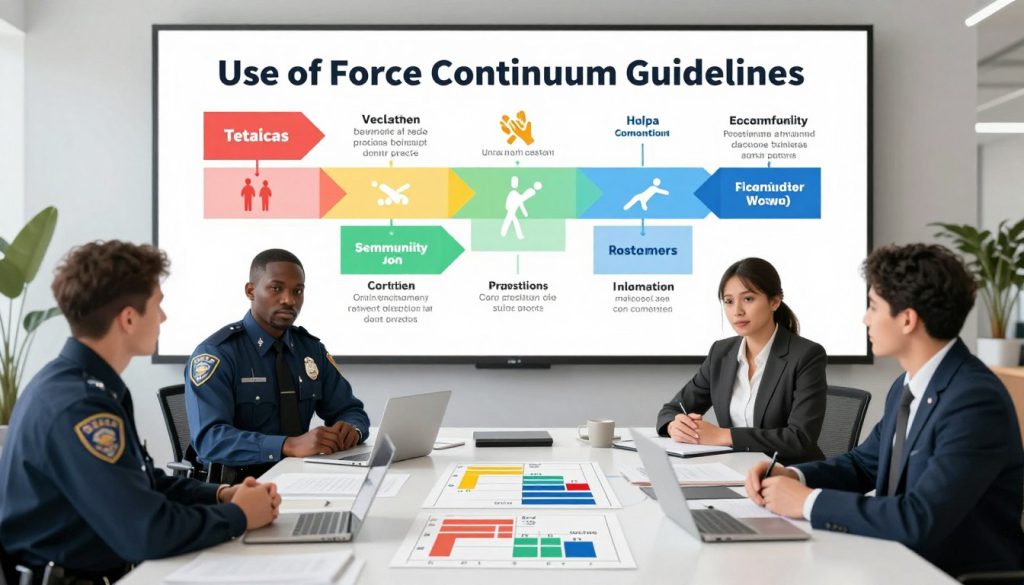
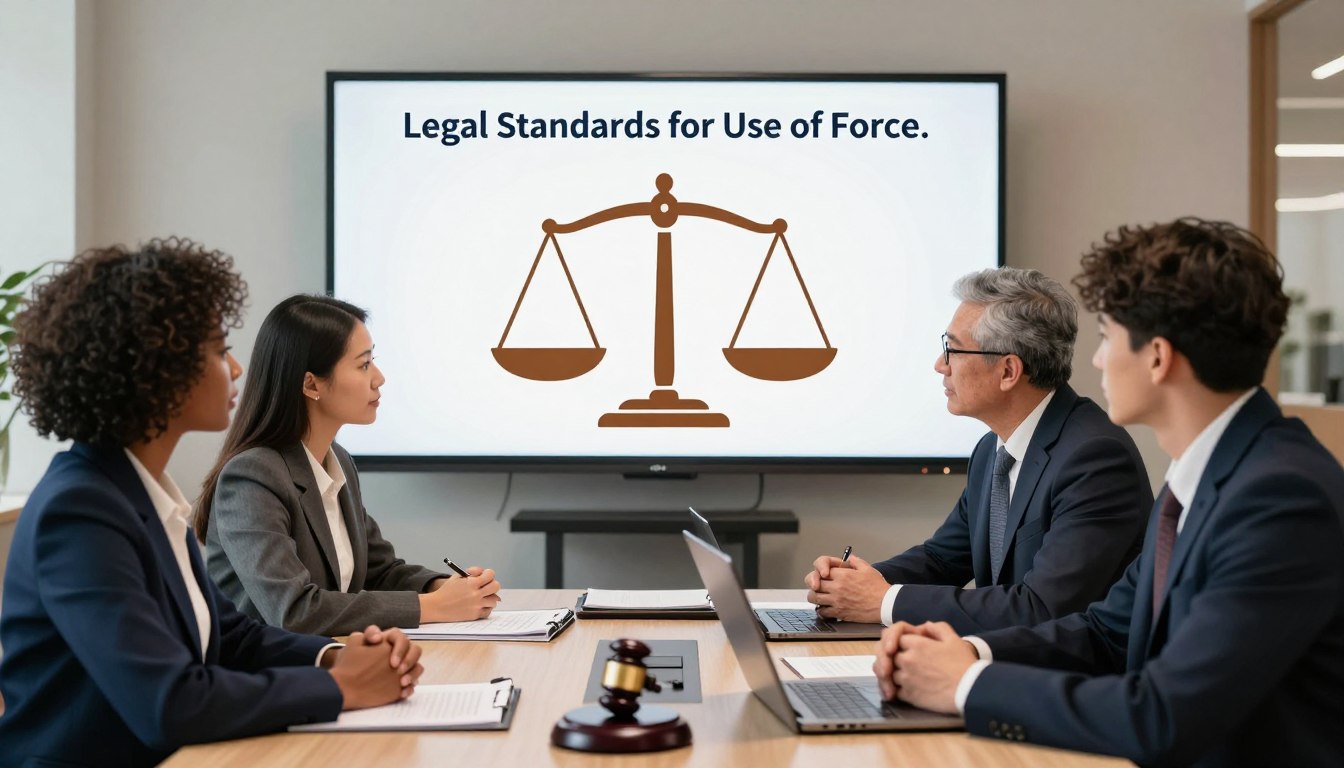
    A visually compelling illustration of the "Use of Force Continuum Guidelines." In the foreground, a diverse group of four professionals in business attire, including a police officer, a lawyer, and two community advocates, are engaged in a discussion around a large table covered with various documents and charts depicting force levels. The middle section shows a detailed, layered infographic displaying the continuum of force, transitioning from verbal commands to physical restraint, designed in an engaging color palette. In the background, a modern office setting with large windows allows natural light to filter in, creating a bright, professional atmosphere. The scene conveys a sense of unity and collaboration, highlighting the importance of developing comprehensive policies and accountability frameworks.

    Setting Specific Use of Force Protocols

    Specific use of force protocols are essential for ensuring that officers respond appropriately to various situations. These protocols should cover different aspects of use of force, including verbal commands, physical control techniques, intermediate weapons authorization, and deadly force criteria.

    Verbal Commands and De-escalation Requirements

    Verbal commands are a crucial first step in resolving situations without resorting to physical force. Officers should be trained in effective communication techniques and de-escalation strategies.

    Physical Control Techniques Standards

    Physical control techniques are used when verbal commands are insufficient. These techniques should be taught as part of the department’s training program, with an emphasis on minimizing the risk of injury to both officers and suspects.

    Technique Description Training Requirement
    Soft Empty Hand Using minimal force to guide or control a suspect Annual Recertification
    Hard Empty Hand Using more forceful techniques to subdue a suspect Bi-Annual Recertification
    Intermediate Force Using tools like batons or Tasers to control a suspect Quarterly Training

    Intermediate Weapons Authorization

    The use of intermediate weapons, such as Tasers or batons, should be strictly regulated. Officers should be authorized to use these weapons only after completing the required training and following department protocols.

    Deadly Force Criteria

    The use of deadly force is subject to the most stringent criteria. Officers should be trained to use deadly force only when there is an imminent threat to their life or the life of others.

    By establishing a comprehensive use of force policy and accountability framework, law enforcement agencies can ensure that their officers are equipped to handle complex situations effectively while maintaining public trust and upholding the principles of accountability and transparency.

    Implementing Effective Training Programs

    The implementation of robust training programs is essential for enhancing law enforcement transparency and preventing police misconduct. Effective training equips officers with the skills and knowledge necessary to handle complex situations, making it a critical component of modern policing.

    Comprehensive training programs should include a variety of components to ensure officers are well-prepared. This includes scenario-based training, de-escalation techniques, and regular recertification requirements, all of which play a vital role in maintaining high standards within law enforcement agencies.

    Scenario-Based Use of Force Training

    Scenario-based training involves simulating real-world situations that officers may encounter, allowing them to practice their decision-making skills in a controlled environment. This type of training is invaluable for preparing officers to respond appropriately to a wide range of scenarios, from routine interactions to high-pressure situations.

    For example, scenario-based training might include simulations of domestic disputes, traffic stops, or encounters with individuals experiencing mental health crises. By practicing these scenarios, officers can develop the skills needed to de-escalate situations and use force only when necessary.
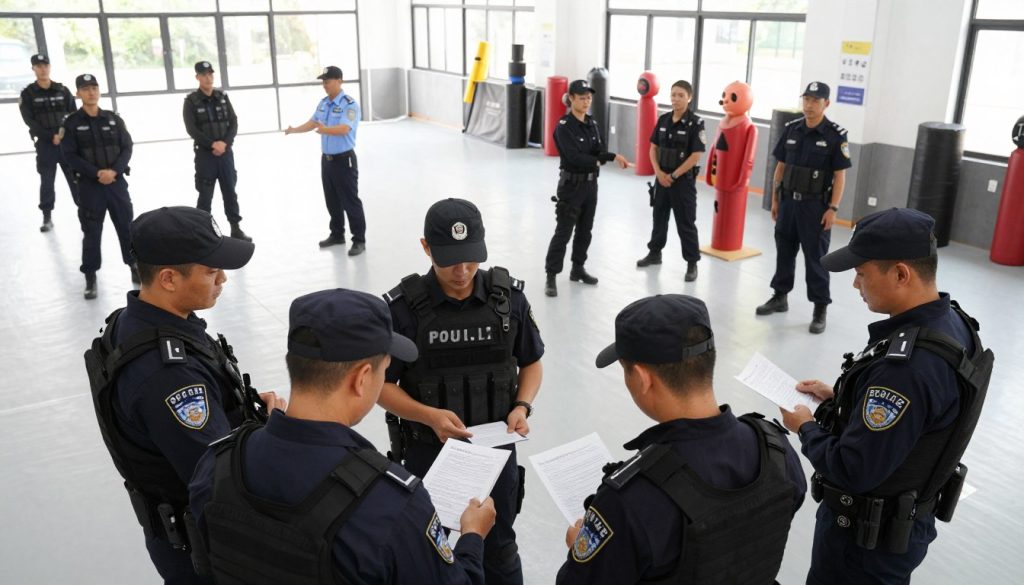
    A dynamic law enforcement training program in action, with a diverse group of officers engaged in a simulated scenario. In the foreground, a group of four officers, dressed in professional tactical gear, reviews guidelines together, concentrating intently on their roles. In the middle ground, a training instructor guides another group as they practice de-escalation techniques, demonstrating effective communication and restraint tactics. The background features a training facility equipped with various props, such as barriers, training dummies, and situational signage, all under bright, natural lighting. The scene conveys a serious yet collaborative atmosphere, emphasizing the importance of effective training in law enforcement. The angle is slightly elevated, capturing both the instructors and trainees and showcasing the interactive nature of the training.

    De-escalation Techniques and Crisis Intervention

    De-escalation techniques are critical for resolving situations without resorting to force. Training in de-escalation involves teaching officers how to communicate effectively, empathize with individuals in crisis, and use verbal and non-verbal techniques to calm tense situations.

    Crisis intervention training is also essential, as it prepares officers to respond to individuals experiencing mental health crises or other emergencies. This training can help reduce the likelihood of misunderstandings or the use of unnecessary force.

    Regular Recertification Requirements

    To ensure that officers remain proficient in their skills and knowledgeable about the latest policies and procedures, regular recertification is necessary. This can involve periodic training sessions, written exams, or scenario-based assessments to verify that officers are meeting the required standards.

    Documentation and Reporting Procedures

    Proper documentation and reporting are crucial for maintaining transparency and accountability within law enforcement agencies. Officers should be trained on the importance of accurate and thorough reporting, including the details required for incident reports and the procedures for submitting them.

    Training Component Description Benefits
    Scenario-Based Training Simulates real-world scenarios for officers to practice decision-making. Prepares officers for a variety of situations, enhancing response appropriateness.
    De-escalation Techniques Teaches officers to communicate effectively and calm tense situations. Reduces the likelihood of force being used unnecessarily.
    Regular Recertification Ensures officers remain skilled and knowledgeable about policies and procedures. Maintains high standards within law enforcement agencies.

    By implementing these comprehensive training programs, law enforcement agencies can significantly enhance law enforcement transparency and reduce the risk of police misconduct. Effective training is a cornerstone of professional policing, contributing to safer communities and improved relationships between law enforcement and the public.

    Establishing Accountability Measures and Oversight Systems

    Implementing accountability measures and oversight systems is essential for preventing misconduct and ensuring compliance with departmental policies and procedures. Effective accountability measures help build trust between law enforcement agencies and the communities they serve.

    A robust accountability system involves multiple layers of oversight, ensuring that any potential misconduct is identified and addressed promptly. This not only enhances transparency but also fosters a culture of accountability within the department.

    Creating Multi-Level Review Processes

    A multi-level review process is critical for thorough investigations and ensuring that all incidents are properly examined. This process involves several stages of review to guarantee fairness and transparency.

    Immediate Supervisor Review

    The first level of review typically involves the officer’s immediate supervisor. This supervisor is responsible for conducting a preliminary assessment of the incident, gathering initial evidence, and determining whether further investigation is required.

    Command Staff Investigation Protocols

    If the incident requires further investigation, it is escalated to the command staff. They follow established protocols to conduct a more in-depth investigation, gathering additional evidence and interviewing witnesses as necessary.

    Independent Review Boards

    For incidents of a serious nature, an independent review board may be convened. This board consists of impartial members who review the evidence and make recommendations regarding disciplinary actions or policy changes.

    Implementing Early Warning Systems

    Early warning systems are designed to identify potential issues before they escalate into serious problems. These systems track officer behavior and flag any unusual patterns or incidents that may indicate a need for intervention or additional training.

    By identifying these issues early, departments can take proactive measures to address them, reducing the risk of misconduct and enhancing overall police accountability measures.

    Setting Disciplinary Guidelines for Policy Violations

    Clear disciplinary guidelines are essential for ensuring that policy violations are addressed consistently and fairly. These guidelines outline the consequences for various types of misconduct, providing a framework for disciplinary actions.

    By having well-defined disciplinary guidelines in place, law enforcement agencies can ensure that officers understand the expectations and consequences of their actions, promoting a culture of compliance with departmental policies and procedures.

    Building Transparency Through Reporting and Public Disclosure

    Law enforcement transparency is not just a necessity, it’s a cornerstone of modern policing. By embracing transparency, law enforcement agencies can foster trust, demonstrate accountability, and improve their relationships with the communities they serve.

    To achieve this level of transparency, several key measures must be implemented. These include thorough documentation of incidents, the use of body-worn cameras, effective public reporting mechanisms, and robust community engagement strategies.

    Mandatory Incident Documentation Requirements

    Accurate and comprehensive documentation of incidents is crucial for transparency. Law enforcement agencies should establish clear guidelines for officers to follow when documenting incidents, including the use of standardized reporting forms and procedures.

    Key elements of incident documentation include:

    • Detailed descriptions of the incident
    • Information about the individuals involved
    • Actions taken by law enforcement officers
    • Any injuries or property damage resulting from the incident

    Body-Worn Camera Policies and Video Review

    The use of body-worn cameras has become an essential tool for enhancing transparency in law enforcement. These cameras provide an objective record of interactions between officers and the public, helping to build trust and accountability.

    Agencies should develop clear policies governing the use of body-worn cameras, including when they should be activated, how footage is stored, and procedures for reviewing and releasing video.

    Public Reporting Mechanisms

    Effective public reporting mechanisms are vital for transparency. Law enforcement agencies should provide regular updates on their activities, including statistics on use of force incidents, complaints against officers, and other relevant data.

    Public reporting can take various forms, such as:

    1. Annual reports detailing agency activities and statistics
    2. Quarterly or monthly updates on specific issues, like use of force
    3. Online portals where the public can access data and reports

    Community Engagement and Feedback Systems

    Community engagement is a critical component of transparency. Law enforcement agencies should actively seek feedback from the public and engage in open dialogue about their practices and policies.

    This can be achieved through various means, including:

    • Regular community meetings and forums
    • Surveys and other feedback mechanisms
    • Social media and other online platforms

    By implementing these measures, law enforcement agencies can significantly enhance their transparency and build stronger, more trusting relationships with the communities they serve.

    Preventing Police Misconduct Through Continuous Improvement

    The key to preventing police misconduct lies in ongoing efforts to refine policies, train officers, and engage with the community. Law enforcement agencies must adopt a proactive approach to identifying areas for improvement and implementing changes that enhance their practices.

    Regular Policy Review and Updates

    Law enforcement policies must evolve to address emerging challenges and societal expectations. Regular reviews ensure that policies remain relevant and effective. Agencies should involve both internal stakeholders and external experts in the review process to gain diverse perspectives.

    Updates to policies should be based on data-driven insights, legal developments, and community feedback. This helps in creating a fair and transparent policing framework.

    Analyzing Use of Force Data and Trends

    Analyzing use of force data is crucial for understanding the effectiveness of current policies and identifying areas for improvement. By examining trends and patterns, agencies can develop targeted strategies to reduce unnecessary force incidents.

    This analysis should be data-driven, using both quantitative and qualitative data to inform policy adjustments and training programs.

    Incorporating Officer Wellness Programs

    Officer wellness is directly linked to their ability to perform their duties effectively and make sound judgments. Wellness programs can help mitigate stress, improve mental health, and enhance overall performance.

    Agencies should invest in comprehensive wellness initiatives that include mental health support, physical fitness programs, and stress management training.

    Building Community Trust and Partnerships

    Building trust with the community is essential for effective policing. Agencies should engage in outreach programs and partnerships that foster positive relationships and facilitate open communication.

    Community policing initiatives can help bridge the gap between law enforcement and the public, promoting mutual understanding and respect.

    Conclusion

    A well-structured use of force policy is crucial for law enforcement agencies to ensure that their practices are both effective and respectful of citizens’ rights. Throughout this article, we have explored the essential components of a comprehensive use of force policy and accountability framework.

    By implementing clear guidelines, providing regular training, and establishing robust accountability measures, law enforcement agencies can reduce the risk of misconduct and promote a culture of transparency and trust. Continuous improvement and community engagement are also vital to ensuring that policing practices remain responsive to the needs of the communities they serve.

    Ultimately, a strong use of force policy and accountability framework is essential for building trust between law enforcement and the public. By prioritizing transparency, accountability, and community engagement, law enforcement agencies can work towards creating safer and more just communities for all.

    FAQ

    What exactly is a use of force policy and accountability framework?

    At its heart, a use of force policy and accountability framework is a set of clear law enforcement guidelines that dictate how and when officers should use physical force. It’s designed to ensure that any action taken is necessary, proportional, and objectively reasonable. By combining these rules with robust accountability procedures, departments can ensure that officers are held responsible for their actions while providing the community with peace of mind that their safety and rights are being protected.

    How do legal standards like the Fourth Amendment influence these policies?

    Constitutional standards, particularly those established by the Supreme Court in cases like Graham v. Connor, serve as the ultimate benchmark. These standards require that force be “objectively reasonable” given the specific circumstances of a situation. Modern departmental policies and procedures take these legal foundations and turn them into actionable steps that officers can follow in the heat of the moment to ensure they remain within the law.

    What are the different levels within use of force protocols?

    Most agencies use a “force continuum” to guide their use of force protocols. This typically starts with officer presence and verbal commands, then moves to de-escalation techniques. If those aren’t enough, it may progress to physical control, intermediate tools like TASER devices, and finally, deadly force as a last resort. The goal is always to use the least amount of force necessary to resolve a situation safely.

    How does specialized training contribute to police misconduct prevention?

    Training is one of our most powerful tools for police misconduct prevention. When officers participate in scenario-based training and de-escalation drills, they learn how to manage high-stress encounters without immediately resorting to physical force. Organizations like the Police Executive Research Forum (PERF) emphasize that continuous education helps officers stay calm and make better decisions, which significantly reduces the likelihood of policy violations.

    What role does technology play in law enforcement transparency?

    Technology is a game-changer for law enforcement transparency. Tools like Axon body-worn cameras provide an objective record of encounters, which protects both the public and the officers. When departments pair this technology with clear public reporting mechanisms, it builds a bridge of trust with the community by showing exactly how police accountability measures are being applied in real-world scenarios.

    How are accountability procedures handled after a force incident?

    When force is used, a multi-level review process kicks in. This usually starts with an immediate supervisor’s review, followed by a deeper dive from internal affairs or command staff. In many modern systems, independent review boards made up of community members also provide oversight. These accountability procedures ensure that every incident is scrutinized to determine if it met the department’s standards and excessive force regulations.

    Why is it important to have an “early warning system” for officers?

    Early warning systems are proactive police accountability measures that help departments identify patterns of behavior before they lead to serious issues. By tracking data like use of force reports or citizen complaints, leadership can step in with additional training or wellness support. It’s a supportive way to maintain high standards and prevent misconduct before it ever starts.

    How often should departmental policies and procedures be updated?

    The world of policing is always evolving, so departmental policies and procedures should be treated as “living documents.” Many leading agencies review their manuals annually to incorporate new laws, technological advancements, and community feedback. Regular updates ensure that excessive force regulations remain effective and that the department is always following the best possible practices for public safety.
  • Self-Defense and Justified Force Laws: What You Need to Know

    Self-Defense and Justified Force Laws: What You Need to Know

    Over thirty states in the United States currently uphold “Stand Your Ground” statutes. This massive number highlights how vital it is to recognize your rights during a conflict. Knowing these rules remains a key part of modern safety.

    Navigating protection rules often feels like a maze. However, following clear self-defense laws provides a solid base for staying safe. Knowing your rights helps you remain collected under pressure.

    Every state applies these rules differently. Learning about justified force ensures you act within the boundaries of the legal system. It empowers you to make quick, smart choices.

    This guide explores the essentials of local protection. Gaining this knowledge is the first step toward true security. Let’s look at what every citizen should understand.

    Key Takeaways

    • Grasping state-specific rules is vital.
    • Protection levels depend on specific threat levels.
    • Some regions require a duty to retreat.
    • Legal knowledge helps manage post-incident stress.
    • Reasonable belief acts as a standard metric.
    • Preparation ensures better decision-making during crises.

    1. Understanding the Legal Foundation of Self-Defense

    The concept of self-defense is deeply rooted in law, and comprehending its legal foundation is vital for individuals to exercise their rights effectively. Self-defense laws vary by jurisdiction, but there are common principles that guide the application of these laws.

    What Constitutes Legal Self-Defense

    Legal self-defense is generally defined as the use of reasonable force to protect oneself from an imminent threat of harm. The key elements include the presence of an immediate threat, the necessity of using force, and the proportionality of the response to the threat.

    Reasonable force is a critical component, meaning the level of force used must be appropriate for the perceived threat. This does not necessarily mean that the force used must be identical to the threat, but it should be proportionate.

    The Reasonable Person Standard

    The reasonable person standard is a legal benchmark used to assess whether the actions taken in self-defense were justified. It asks whether a reasonable person, in the same circumstances, would have perceived the threat as imminent and responded similarly.

    This standard is subjective and can vary significantly depending on the jurisdiction and specific circumstances of the case.

    Imminent Threat Requirements

    An imminent threat is a critical element for a valid self-defense claim. It refers to a threat that is immediate and unavoidable, leaving no reasonable opportunity for alternative actions such as retreat.

    Defining Imminent vs Future Threats

    Distinguishing between imminent and future threats is crucial. An imminent threat is one that is about to occur, whereas a future threat is anticipated but not immediate. Self-defense laws typically require the threat to be imminent.

    Pre-emptive Action and Legal Risks

    Taking pre-emptive action against a perceived future threat can be legally risky. While it may be justified in some cases, it often raises complex legal questions about the legitimacy of the perceived threat and whether the action was necessary.

    Individuals considering pre-emptive action must carefully assess the situation and, if possible, seek legal counsel to understand the potential legal implications.

    2. Key Elements of Justified Force in Self-Protection

    The use of force in self-protection is a complex issue that involves several key elements. When individuals find themselves in situations where they must defend themselves, understanding these elements can be the difference between a justified action and a criminal offense.

    Proportionality: Matching Force to Threat

    One of the fundamental principles of justified force is proportionality. This means that the level of force used in self-defense should be proportional to the threat faced. Using excessive force against a minor threat can lead to legal repercussions. For instance, using lethal force against someone who is merely pushing you could be considered disproportionate.

    Necessity: When Force Becomes Required

    The necessity of using force is another critical factor. Force is considered necessary when it is the only means available to prevent imminent harm. If there are other reasonable alternatives, such as retreating or de-escalating the situation, these should be considered before resorting to force.

    Scenario Force Used Justification
    Physical assault Physical defense Generally justified if proportional
    Threat with a weapon Lethal force May be justified depending on the jurisdiction and perceived threat
    Verbal threat without weapon Lethal force Typically not justified

    Perception vs Reality in Self-Defense Claims

    The role of perception versus reality is significant in self-defense claims. The courts often consider whether the individual’s perception of the threat was reasonable, even if the threat was not real. This subjective assessment can greatly impact the justification of force used in self-defense.

    Understanding these key elements—proportionality, necessity, and the impact of perception—is essential for individuals to navigate the complex legal landscape surrounding self-defense and justified force.

    3. Understanding Castle Doctrine Laws

    Understanding the legal protections afforded by the Castle Doctrine is crucial for homeowners and individuals who wish to defend themselves and their property. The Castle Doctrine is a legal principle that varies by jurisdiction but generally allows individuals to use force, including deadly force, to defend their homes against intruders without a duty to retreat.

    What the Castle Doctrine Protects

    The Castle Doctrine primarily protects individuals within their homes, or “castles,” from intruders. It is based on the idea that a person’s home is their safest refuge and that they should not be required to retreat from their own home when faced with an intruder. This doctrine is often associated with the concept of self-defense and is designed to protect not just the individual but also their family and property.

    Your Legal Rights Within Your Home

    Within your home, you have significant legal rights to defend yourself and your family. The specifics can vary by state, but generally, the Castle Doctrine presumes that an intruder poses a significant threat. This means that if someone unlawfully enters your home, you may be justified in using force to protect yourself and your loved ones. It’s essential to understand that the use of force must be reasonable and proportionate to the threat posed.

    Extensions to Vehicles and Occupied Spaces

    While the Castle Doctrine traditionally applies to homes, some jurisdictions extend these protections to other areas, such as vehicles or other occupied spaces. For instance, if you are in your vehicle and faced with a threat, you may be legally justified in defending yourself under the Castle Doctrine, depending on your state’s laws. Understanding these extensions is crucial for knowing your rights in various situations.

    Workplace and Business Property Considerations

    The application of the Castle Doctrine can also extend to workplace or business property in some jurisdictions. This can be more complex, as the laws regarding the use of force in commercial settings can vary significantly. Business owners should be aware of their state’s laws regarding self-defense in the workplace, as the rules can differ from those applying to personal residences. It’s also worth noting that employers may have additional responsibilities and considerations when it comes to ensuring a safe work environment.

    By understanding the Castle Doctrine and its applications, individuals can better protect themselves and their properties, knowing their legal rights and responsibilities.

    4. Stand Your Ground Law Explained

    In the realm of self-defense, Stand Your Ground laws play a pivotal role in determining the legality of one’s actions. These laws, part of the broader justified force statutes, vary by state and have significant implications for individuals claiming self-defense.

    Stand Your Ground vs Duty to Retreat

    The primary distinction between Stand Your Ground and Duty to Retreat laws lies in the obligation to attempt to retreat before using force in self-defense. Stand Your Ground laws eliminate the duty to retreat in certain situations, allowing individuals to stand their ground and defend themselves without first attempting to flee.

    In contrast, Duty to Retreat laws require individuals to attempt to safely retreat before using force. This fundamental difference can significantly impact the outcome of self-defense claims.

    Which States Have Stand Your Ground Laws

    Several states have enacted Stand Your Ground laws, but the specifics can vary widely. Some of the states with such laws include Florida, Texas, and Georgia. It’s essential to understand the specific provisions in your state.

    State Stand Your Ground Law Key Provisions
    Florida Yes No duty to retreat in any place where one has a right to be
    Texas Yes Applies to one’s home, vehicle, or other places where one has a right to be
    Georgia Yes Extends to include the use of deadly force in certain circumstances

    Important Limitations and Exceptions

    While Stand Your Ground laws provide significant protections, they are not without limitations and exceptions. Understanding these is crucial for applying the law correctly.

    When Stand Your Ground Doesn’t Apply

    Stand Your Ground laws typically do not apply in situations where the individual is engaged in unlawful activity or is the initial aggressor. Additionally, the law may not protect individuals who use excessive force or act with malice.

    It’s critical to note that the specifics of these laws and their applications can vary, making it essential to consult with legal professionals in your jurisdiction.

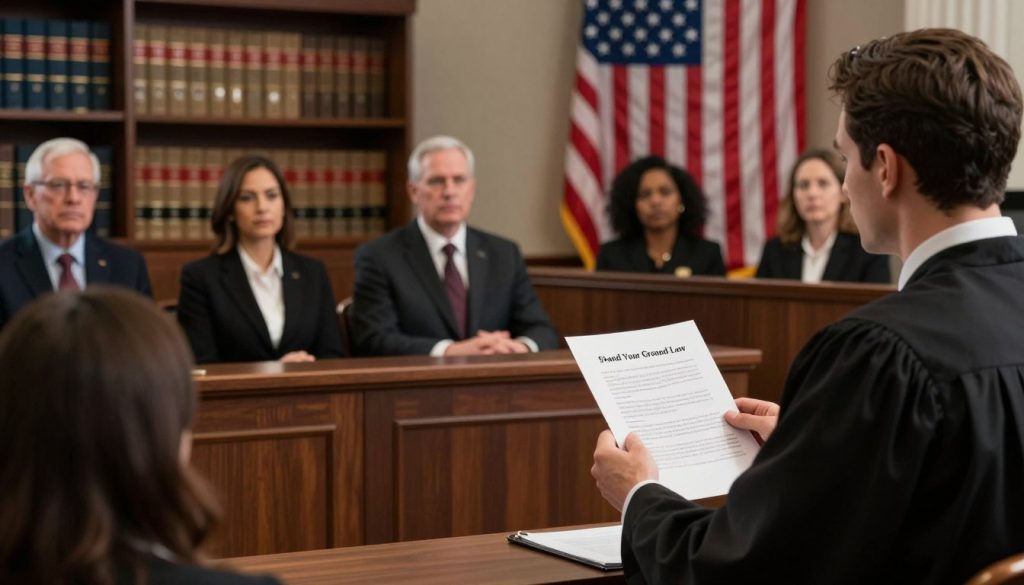
    A courtroom scene with a judge presiding, surrounded by lawyers and jurors, all dressed in professional attire. In the foreground, a lawyer passionately presenting a case about the "Stand Your Ground Law," holding a legal document in one hand, gesturing with the other. The middle ground features attentive jurors, their expressions serious as they listen intently. The background reveals bookshelves filled with law books and a large American flag behind the judge, symbolizing justice. The lighting is warm and focused, highlighting the lawyer while casting softer shadows in the background. The atmosphere is tense yet respectful, embodying the gravity of self-defense laws and legal proceedings. The image should evoke a sense of deliberation and importance.

    5. Navigating Lethal Force Regulations

    Understanding the legal nuances of lethal force is crucial for individuals to protect themselves without inadvertently breaking the law. The regulations surrounding lethal force are complex and vary by jurisdiction, making it essential to comprehend the specific laws in your area.

    When Lethal Force Is Legally Justified

    Lethal force is generally considered justified when an individual reasonably believes it is necessary to prevent imminent death or serious bodily harm to themselves or others. This principle is rooted in the concept of self-defense and the right to protect one’s life and the lives of others.

    The Standard for Deadly Threat

    The standard for determining a deadly threat typically involves an assessment of whether the threat is imminent and whether the force used is proportionate to the threat posed.

    Reasonable Fear of Death or Serious Bodily Harm

    A key factor in justifying the use of lethal force is the presence of a reasonable fear of death or serious bodily harm. This fear must be based on objective criteria and not solely on the individual’s subjective perception.

    Non-Lethal vs Lethal Response Options

    When faced with a threat, individuals have various response options, ranging from non-lethal to lethal force. The choice between these options depends on the severity of the threat and the perceived level of danger.

    • Non-Lethal Options: These include verbal de-escalation techniques, pepper spray, and stun guns, which can be effective in neutralizing a threat without causing permanent harm.
    • Lethal Force: Reserved for situations where there is a significant and imminent threat to life or serious bodily harm, lethal force is a last resort that should be used with extreme caution.

    Warning Shots and Brandishing: Legal Pitfalls

    The use of warning shots or brandishing a weapon can have significant legal implications. While intended to deter a threat, these actions can escalate a situation or be misinterpreted, leading to legal repercussions.

    “The decision to use force, whether lethal or non-lethal, should always be guided by the principle of proportionality and the legal standards in your jurisdiction.”

    In conclusion, navigating lethal force regulations requires a thorough understanding of the legal framework governing its use. By being informed and cautious, individuals can better protect themselves and others while minimizing the risk of legal consequences.

    6. Defense of Others Law: Protecting Third Parties

    The laws surrounding defense of others are multifaceted, involving considerations of proportionality, necessity, and the relationship between the defender and the person being defended. When individuals intervene to protect others, they must navigate a complex legal landscape that varies by jurisdiction. Understanding these laws is crucial for making informed decisions in high-pressure situations.

    Legal Standards for Defending Others

    The legal standards for defending others generally mirror those for self-defense, emphasizing the use of reasonable force in response to an imminent threat.Reasonable forceis typically defined as the amount of force that a prudent person would deem necessary to protect the third party from harm. This standard requires an objective assessment of the situation, taking into account the perceived threat and the defender’s response.

    In many jurisdictions, the defender is entitled to use force on behalf of another person if they reasonably believe that the third party is entitled to use self-defense. This principle is grounded in the idea that an individual should be able to protect others from harm, just as they would protect themselves.

    Stranger vs Family Member: Does Relationship Matter

    The relationship between the defender and the person being defended can influence the legal outcome of a defense of others claim. While some jurisdictions do not differentiate based on the relationship, others may consider it a factor in determining the reasonableness of the defender’s actions. For instance, a defender who is a family member might be viewed more sympathetically if they acted to protect a relative, due to the presumed closer relationship and potentially greater emotional investment in the well-being of the family member.

    However, the law generally does not require a specific relationship between the defender and the third party for the defense of others to be valid. Strangers who intervene to protect others can also claim defense of others, provided they meet the necessary legal standards.

    Relationship Legal Consideration Potential Impact
    Family Member May be viewed more sympathetically Positive impact on legal outcome
    Stranger Entitled to use force if reasonable Neutral or case-dependent impact

    The Danger of Misidentifying Aggressor and Victim

    One of the significant risks in defending others is the potential to misidentify the aggressor and the victim. If an individual intervenes on behalf of someone who is actually the aggressor, they may face legal consequences for their actions. This misidentification can lead to criminal charges or civil liability, highlighting the importance of carefully assessing the situation before taking action.

    To mitigate this risk, defenders should attempt to de-escalate the situation if possible and use the minimum necessary force to protect the perceived victim. Additionally, being aware of the surroundings and understanding the context of the conflict can help in making a more accurate assessment of the situation.

    A dramatic scene depicting the concept of the "Defense of Others Law". In the foreground, two individuals in professional business attire are seen intervening in a tense situation, with one person reaching out protectively to another who appears to be distressed. The middle ground includes a blurred background of a city street, hinting at an urban environment where the action unfolds. Soft but focused lighting illuminates the faces of the interveners, highlighting their determination and urgency. The atmosphere is tense yet empowering, with a warm golden hour glow casting long shadows, signifying both urgency and hope in protecting a vulnerable individual. A wide-angle perspective captures the essence of the scene, enhancing the feelings of movement and urgency.

    7. Self-Defense and Justified Force Laws: Practical Steps to Stay Legal

    To navigate the complex world of self-defense laws, it’s essential to know the practical steps that keep you legally protected. Understanding and applying these steps can significantly reduce the risk of legal repercussions when defending yourself or others.

    Step 1: Research and Understand Your State’s Specific Laws

    Self-defense laws are not uniform across the United States; they vary significantly from state to state. Therefore, the first step is to research and understand the specific laws in your jurisdiction.

    Finding Reliable Legal Resources

    To find accurate information, consult official state government websites, legal databases, or reputable law firms that specialize in self-defense laws. Reliable sources are crucial for understanding the nuances of your state’s laws.

    Consulting with a Self-Defense Attorney

    When in doubt, consulting with an attorney who specializes in self-defense laws can provide personalized guidance and clarity on your specific situation. They can help you understand how the law applies to your circumstances.

    Step 2: Assess the Threat Level Before Taking Action

    Assessing the threat level is critical before taking any self-defense action. This involves evaluating the situation to determine if there is a genuine threat.

    Identifying True Threats vs Verbal Confrontations

    Distinguishing between verbal confrontations and physical threats is vital. While verbal threats can be intimidating, they may not always justify physical self-defense. Understanding the difference is key to making the right decision.

    Reading Body Language and Intent

    Being able to read body language and understand the intent of the other party can help you assess the level of threat. Non-verbal cues can often provide critical information about someone’s intentions.

    Step 3: Attempt De-escalation When Safely Possible

    Whenever possible, attempting to de-escalate a confrontation is a recommended step before resorting to physical self-defense. De-escalation techniques can prevent the situation from becoming more violent.

    Step 4: Use Only the Minimum Necessary Force

    The principle of using only the minimum necessary force is fundamental in self-defense laws. Using excessive force can lead to legal consequences, even if you were initially justified in defending yourself.

    Escalating Force Appropriately

    Understanding when and how to escalate force appropriately is crucial. The goal is to neutralize the threat with the least amount of force necessary.

    Step 5: Stop Immediately When the Threat Ends

    Once the threat has been neutralized or has ended, it’s essential to stop any further defensive actions. Continuing to use force after the threat has passed can lead to legal issues.

    Step 6: Call Law Enforcement and Report the Incident

    After a self-defense incident, it’s crucial to call law enforcement and report what happened. Being cooperative and transparent with law enforcement can help clarify the circumstances surrounding the incident.

    What to Say and What Not to Say

    When reporting the incident, it’s essential to be factual and avoid making speculative statements. Sticking to the facts can help prevent misinterpretation of your actions.

    Step 7: Preserve Evidence and Seek Legal Representation

    Preserving any evidence related to the incident, such as witness statements or physical evidence, can be vital for your legal protection. Additionally, seeking legal representation early on can provide you with professional guidance throughout the legal process.

    8. Conclusion

    Navigating the complexities of self-defense and justified force laws can be challenging, but it’s crucial for making informed decisions in critical situations. Throughout this article, we’ve explored the legal foundations, key elements, and practical steps to stay within the bounds of these laws.

    Self-defense laws and justified force statutes vary by state, making it essential to understand the specific regulations in your jurisdiction. By grasping the concepts of proportionality, necessity, and the reasonable person standard, you can better assess when force is justified.

    As you’ve learned, laws such as the Castle Doctrine and Stand Your Ground provide additional context for when force can be legally used. By following the practical steps outlined, you can minimize risks and ensure you’re acting within the law if you ever find yourself in a self-defense situation.

    Staying informed about self-defense laws and justified force statutes is key to protecting yourself and others while avoiding legal repercussions. By being aware of your rights and responsibilities, you can make more informed decisions in high-pressure situations.

    FAQ

    What exactly qualifies as the legal use of force in a self-defense situation?

    Generally, the legal use of force is permitted when you reasonably believe it is necessary to protect yourself from the immediate use of unlawful force by another person. Under most justified force statutes, your actions are judged by the “reasonable person standard,” meaning a jury will consider if a calm, rational person in your exact position would have acted the same way to ensure their safety.

    How do self-defense guidelines define an “imminent threat”?

    An imminent threat is one that is happening right now or is about to happen in the very next second. According to standard self-defense guidelines, you cannot use force to prevent a future threat—such as someone saying they will come back tomorrow to hurt you. The danger must be immediate, leaving you with no other choice but to act in use of force in self-protection.

    What is the difference between a Stand Your Ground law and the “Duty to Retreat”?

    In states with a stand your ground law, you are not required to run away or retreat before using force, provided you are in a place where you have a legal right to be. Conversely, states with a “duty to retreat” require you to attempt to safely leave the situation before resorting to force, unless you are in your own home.

    How does the Castle Doctrine protect me inside my home or vehicle?

    The castle doctrine is a legal principle that grants you the right to use force—sometimes even lethal force—to protect yourself against an intruder in your home without the obligation to retreat. Many states have expanded this to include your personal vehicle or workplace, recognizing these spaces as extensions of your “castle” where you have a high expectation of safety.

    Can I be protected under defense of others law if I step in to help a stranger?

    Yes, the defense of others law generally allows you to use force to protect a third party if you reasonably believe that person is in immediate danger. However, this can be legally risky; if you misidentify the aggressor and accidentally defend the person who started the fight, you may not be protected by justified force laws.

    What are the lethal force regulations regarding the “proportionality” of my response?

    A: Lethal force regulations are very strict: you may only use deadly force if you have a reasonable fear of imminent death or “great bodily harm.” The concept of proportionality means you cannot bring a gun to a fistfight unless there is an extreme disparity in size, numbers, or ability that makes the threat deadly.

    Is it legal to fire a warning shot or “brandish” a weapon to scare someone off?

    Usually, no. In many jurisdictions, firing a warning shot or brandishing a firearm can lead to charges of aggravated assault or reckless endangerment. Self-defense laws typically view the discharge of a firearm as an act of lethal force, regardless of whether you intended to hit the person or just scare them.

    Should I seek legal representation from a specialist like U.S. LawShield after a self-defense incident?

    Absolutely. Even if you were 100% justified, the legal aftermath of a use of force in self-protection incident can be incredibly complex. Organizations like U.S. LawShield or CCW Safe provide access to specialized attorneys who understand justified force statutes and can help you navigate police questioning and potential court proceedings to ensure your rights are protected.
  • Constitutional Protections Against Excessive Police Force

    Constitutional Protections Against Excessive Police Force

    Did you know the Supreme Court first set clear rules for officer behavior in 1989? Before then, local standards varied wildly across the country. Today, the Bill of Rights provides vital civil liberties for every citizen.

    Knowing the constitutional limits on police force keeps you safe. These legal standards ensure that officials remain fair during any encounter. If an individual faces harsh treatment, they can seek justice through the courts.

    Awareness of these rules gives you power. It helps maintain a fair society where everyone stays respected. This guide aims to simplify your rights clearly. We hope this information makes you feel secure. Let us dive into the details now.

    Key Takeaways

    • The Fourth Amendment guards against unreasonable seizures.
    • Legal standards require officers to use reasonable methods.
    • Civil liberties protect individuals during traffic stops.
    • Citizens may record interactions within public spaces.
    • Awareness promotes safety for everyone involved.
    • Unfair actions can lead to legal consequences for agencies.

    1. Understanding Your Constitutional Rights During Police Encounters

    The Constitution provides specific protections for individuals during police encounters, and understanding these rights is essential. During interactions with law enforcement, citizens are protected by several constitutional amendments that limit the power of police officers.

    The Fourth Amendment Protection Against Unreasonable Seizures

    The Fourth Amendment safeguards individuals against unreasonable seizures, which include arrests and detentions. This amendment requires law enforcement to have probable cause before seizing or arresting someone.

    The Fourteenth Amendment Due Process Clause

    The Fourteenth Amendment’s Due Process Clause ensures that individuals are treated fairly and that their rights are not violated by state or local authorities. It protects against arbitrary actions by government officials, including police officers.

    How These Rights Work Together to Protect You

    Together, the Fourth and Fourteenth Amendments create a robust protection framework for individuals during police encounters. Understanding these rights can help you recognize when they are being violated.

    Amendment Protection Application
    Fourth Amendment Protection against unreasonable seizures Requires probable cause for arrests and detentions
    Fourteenth Amendment Due Process Clause Ensures fair treatment by state and local authorities

    2. What Legally Constitutes Excessive Police Force

    The legal definition of excessive police force is a critical aspect of understanding your constitutional protections. It is determined by the objective reasonableness standard, which assesses whether the force used by police was necessary given the circumstances.

    The Objective Reasonableness Standard Explained

    The objective reasonableness standard is a legal benchmark used to evaluate whether the force used during a police encounter was justified. This standard considers the perspective of a reasonable officer on the scene, taking into account the information available at the time.

    Key Factors Courts Use to Evaluate Police Force

    Courts examine several factors when determining if the police force used was excessive. These include:

    Severity of the Suspected Crime

    The more severe the crime, the more likely it is that a higher level of force may be deemed reasonable.

    Whether You Pose an Immediate Threat

    If you pose a significant threat to the officer or others, greater force may be justified.

    Whether You Are Resisting or Attempting to Flee

    Active resistance or flight can influence the level of force considered reasonable.

    Factor Consideration Impact on Force Justification
    Severity of Crime More severe crimes may justify higher force Increases likelihood of force being deemed reasonable
    Immediate Threat Significant threat to officer or others Justifies greater force
    Resisting or Fleeing Active resistance or attempt to flee May justify increased force

    Real-World Examples of Excessive Force

    Examples of excessive force include using lethal force against unarmed individuals who do not pose an immediate threat.

    Understanding these factors and the objective reasonableness standard can help clarify when police actions may cross the line into excessive force.

    3. How to Recognize When Your Rights Are Being Violated

    Knowing how to identify violations of your rights during police interactions can be a powerful tool. It empowers you to stand up for yourself and seek justice when necessary.

    Warning Signs of Excessive Force in Action

    Excessive force can manifest in various ways, including physical violence, verbal abuse, and unnecessary use of restraints. Be aware of the following signs:

    • Police using pepper spray, batons, or other weapons without justification
    • Officers applying handcuffs too tightly or using chokeholds
    • Verbal commands that are aggressive or demeaning

    Understanding Lawful Versus Unlawful Use of Force

    Lawful use of force is typically proportionate to the threat posed and follows established protocols. Unlawful force, on the other hand, is excessive and violates constitutional protections. Understanding this distinction is key to recognizing rights violations.

    Common Situations Where Violations Frequently Occur

    Violations can occur during arrests, traffic stops, and searches. Be particularly cautious in situations where you’re not posing an immediate threat but are still subjected to aggressive police behavior.

    4. Constitutional Limits on Police Force You Should Know

    The Constitution sets clear boundaries on the use of force by law enforcement officers. These boundaries are designed to protect citizens from excessive police force while allowing officers to perform their duties effectively.

    Legal Boundaries That Restrict Officer Actions

    Law enforcement officers are subject to constitutional limits that dictate when and how they can use force. These limits are primarily derived from the Fourth Amendment, which protects against unreasonable seizures, and the Fourteenth Amendment, which ensures due process.

    The Proportionality Principle in Action

    The proportionality principle is a key concept in determining whether the use of force by police is justified. It requires that the level of force used be proportionate to the threat posed by the individual.

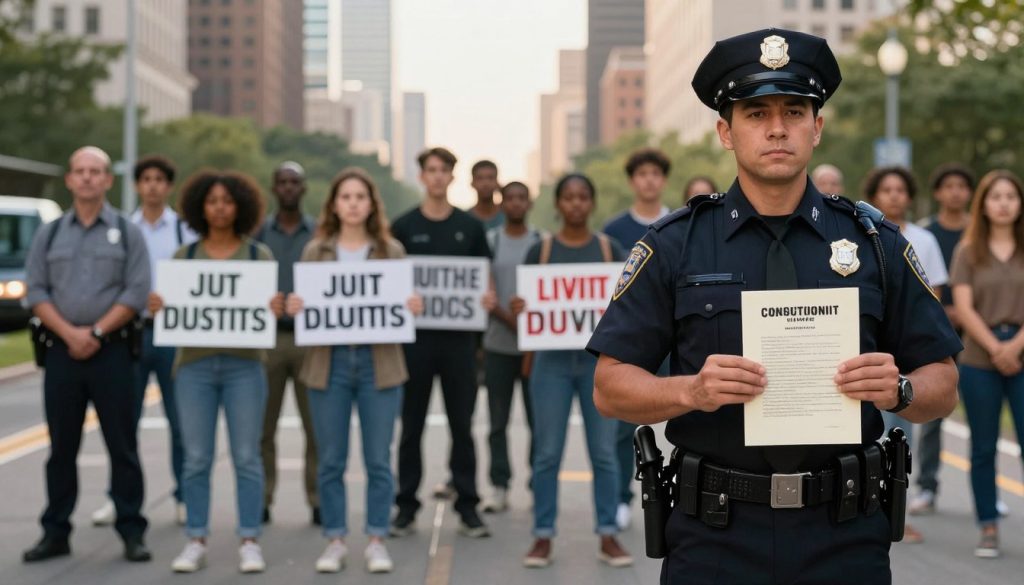
    A dramatic scene illustrating the concept of constitutional limits on police force. In the foreground, a police officer in professional attire stands upright, expressing a sense of duty, while holding a constitution document prominently in one hand. In the middle ground, a diverse group of citizens representing various backgrounds stands in peaceful protest, holding placards advocating for justice and accountability. In the background, a well-lit cityscape creates a sense of urban life, with soft, warm lighting to evoke hope. The composition captures the tension between authority and citizens’ rights, suggesting balance and order amid a powerful message. The atmosphere should feel respectful yet assertive, emphasizing the importance of constitutional protections without depicting violence or conflict.

    Strict Limitations on Deadly Force

    The use of deadly force by police is subject to strict limitations. Officers are generally only permitted to use deadly force when there is a significant threat to their life or the lives of others.

    Special Protections for Non-Threatening Individuals

    Individuals who are not posing a threat to law enforcement officers or others are entitled to special protections. The use of force against non-threatening individuals is considered excessive and is not permitted under the Constitution.

    5. Step-by-Step Guide to Protecting Yourself During Police Encounters

    Protecting yourself during police encounters requires a combination of knowledge and calm behavior. When faced with law enforcement, it’s essential to understand your rights and how to assert them effectively.

    Step 1: Remain Calm and Begin Mental Documentation

    Staying calm allows you to think clearly and make rational decisions. Begin mentally documenting the encounter, noting the time, location, and the officers’ badge numbers and names if possible.

    Step 2: Clearly State Your Constitutional Rights

    You have the right to remain silent and to ask for an attorney. Clearly stating these rights can help de-escalate the situation and protect your legal interests.

    Step 3: Never Physically Resist While Verbally Objecting

    While you should not physically resist arrest, you can verbally object to the actions of the police. This can help establish a record of your objections and potentially support your case if needed.

    Step 4: Immediately Request Medical Attention for Any Injuries

    If you’re injured during the encounter, request medical attention immediately. This not only ensures your well-being but also documents your injuries, which can be crucial for any future legal actions.

    6. What to Do After Experiencing Excessive Police Force

    Being prepared and knowing what to do after experiencing excessive police force can help protect your rights and interests. The actions you take immediately following such an incident are crucial.

    Step 1: Get Medical Treatment and Secure Documentation

    Seeking medical treatment immediately after the incident is vital. Not only does it ensure your well-being, but it also provides documentation of your injuries.

    Step 2: Collect and Preserve All Available Evidence

    Collecting evidence is a critical step. This includes taking photographs of your injuries and any relevant scenes, preserving video footage if available, and obtaining witness contact information.

    Taking Photographs and Preserving Video

    Visual evidence can be compelling. Take clear, dated photographs of your injuries and preserve any video footage that may have captured the incident.

    Obtaining Witness Contact Information

    Witnesses can provide valuable testimony. Ensure you collect their contact information for future reference.

    Writing Your Detailed Account

    As soon as possible, write down a detailed account of what happened. Include as many specifics as you can remember.

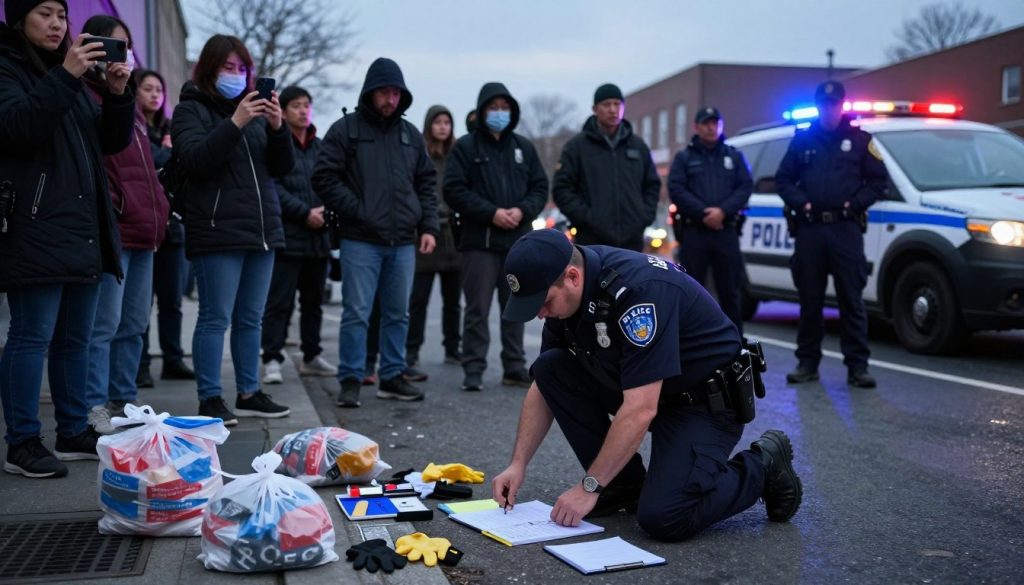
    A tense urban scene depicting a police officer in professional attire, collecting evidence at the site of an incident involving excessive police force. In the foreground, the officer kneels, examining the ground closely for any relevant evidence, surrounded by an array of forensic tools like evidence bags, gloves, and note-taking materials. The middle ground features a crowd of concerned citizens, standing at a distance, some recording the event on their smartphones, their expressions a mix of curiosity and unease. In the background, a police vehicle is parked with flashing lights, creating a stark contrast against the muted evening light. The atmosphere is somber and tense, emphasized by overcast skies and low lighting, conveying a sense of urgency and seriousness about the investigation. Use a wide-angle lens to capture the intensity of the scene.

    Step 3: File Formal Complaints Through Proper Channels

    Filing a formal complaint is essential. This can typically be done through the police department’s internal affairs division or a civilian complaint board.

    Step 4: Consult with a Civil Rights Attorney

    Consulting with a civil rights attorney can provide you with the guidance needed to navigate the legal process and protect your rights.

    Action Purpose
    Get Medical Treatment Ensure well-being and document injuries
    Collect Evidence Support your case with visual and testimonial evidence
    File a Formal Complaint Notify the authorities and start the legal process
    Consult a Civil Rights Attorney Navigate the legal system and protect your rights

    7. Legal Remedies and Support Resources at Your Disposal

    Those who have faced excessive police force can turn to the law for support and justice. Understanding the available legal remedies is crucial for victims seeking recourse.

    Pursuing a Section 1983 Federal Civil Rights Claim

    A Section 1983 claim allows individuals to sue state actors, including police officers, for violating their constitutional rights. This federal law provides a powerful tool for holding law enforcement accountable for their actions.

    Understanding Criminal Prosecution Possibilities

    In cases of severe misconduct, criminal prosecution may be pursued against offending officers. This process involves the state or federal government bringing charges against the officers involved.

    Filing Internal Police Department Grievances

    Filing a complaint with the police department’s internal affairs division is another avenue for addressing grievances. This process allows for an internal investigation into the alleged misconduct.

    Organizations Ready to Assist You

    Several organizations provide support and legal assistance to victims of police brutality. These include:

    American Civil Liberties Union (ACLU)

    The ACLU is a prominent organization dedicated to protecting individual rights and liberties, including those related to police misconduct.

    National Police Accountability Project

    This organization focuses on holding law enforcement accountable through legal action and advocacy.

    State and Local Legal Aid Organizations

    Various state and local organizations offer legal aid and support to individuals dealing with police misconduct issues.

    Organization Focus Services
    ACLU Protecting individual rights and liberties Legal assistance, advocacy
    National Police Accountability Project Holding law enforcement accountable Legal action, advocacy
    State and Local Legal Aid Organizations Providing legal aid to individuals Legal assistance, support

    Protecting Your Rights and Promoting Police Accountability

    Understanding your constitutional protections against excessive police force is crucial in maintaining a fair and just society. The Fourth and Fourteenth Amendments provide essential safeguards against unreasonable seizures and ensure due process.

    By being aware of your rights and recognizing the signs of excessive force, you can protect yourself during police encounters. If you experience or witness police misconduct, seeking help and reporting incidents are vital steps toward promoting police accountability.

    Leveraging resources such as filing formal complaints, consulting with a civil rights attorney, and pursuing legal remedies can help ensure that your rights are upheld. By standing together for constitutional protections, we can foster a culture of transparency and accountability within law enforcement agencies.

    FAQ

    Which specific parts of the Constitution protect me from excessive police force?

    Your primary protections come from the Fourth Amendment, which guards against unreasonable seizures, and the Fourteenth Amendment, which ensures due process. Together, these amendments establish the legal framework that requires officers to respect your personal liberty and physical safety during any encounter.

    What is the “objective reasonableness” standard used by courts?

    The objective reasonableness standard is the benchmark courts use to determine if an officer’s use of force was lawful. Instead of looking at the officer’s intent, judges evaluate the facts of the situation, such as the severity of the suspected crime, whether the individual posed an immediate threat, and if the person was resisting or attempting to flee at that exact moment.

    Are there strict limits on when a police officer can use deadly force?

    Yes, there are significant constitutional limits. Officers are generally prohibited from using deadly force unless it is necessary to prevent escape and the officer has probable cause to believe that the suspect poses a significant threat of death or serious physical injury to the officer or others. The proportionality principle dictates that the level of force must match the level of threat provided.

    What should I do if I believe my rights are being violated during a police encounter?

    The most important thing is to remain calm and avoid physical resistance, even while you are verbally objecting to the treatment. Clearly state your constitutional rights, such as your right to remain silent, and try to make a mental note of the officers’ names or badge numbers. As soon as the encounter ends, immediately request medical attention for any injuries to ensure there is a professional record of the incident.

    How can I properly document an instance of excessive force after it happens?

    To build a strong case, you should collect and preserve all available evidence. This includes taking photographs of injuries, preserving video footage from bystanders, and obtaining witness contact information. Writing a detailed account of the event while the memory is fresh is also a crucial step before you file formal complaints through internal police department channels.

    What is a Section 1983 federal civil rights claim?

    A Section 1983 claim is a powerful legal tool that allows individuals to sue government officials, including police officers, in federal court for violating their constitutional rights. This is the primary pathway for seeking financial compensation and accountability for victims of unlawful use of force.

    Which organizations can provide support if I have been a victim of police misconduct?

    Several reputable organizations are dedicated to helping citizens navigate these difficult situations. You can reach out to the American Civil Liberties Union (ACLU) or the National Police Accountability Project (NPAP) for resources and legal guidance. Additionally, many state and local legal aid organizations offer specialized assistance for those pursuing civil rights grievances.
  • Excessive Force Civil Litigation: Protecting Your Rights

    Excessive Force Civil Litigation: Protecting Your Rights

    Did you know that police officers in the United States fatally shoot over 1,000 people every single year? This startling statistic highlights a significant requirement for public awareness and strong legal protections. When interactions with the law turn violent, the impact creates lasting emotional trauma for families and communities.

    Navigating a formal legal battle for justice might seem like an uphill struggle for many victims. However, standing up for your dignity is a vital part of the American justice system. This path allows everyday citizens to hold government officials responsible for their physical actions.

    Starting the process of excessive force civil litigation ensures that constitutional rights stay strong and relevant. We will walk you through the fundamental procedures of building a robust case. Your future safety and your legal voice matter deeply in this pursuit of fairness.

    Key Takeaways

    • Understand how to identify violations of your constitutional rights.
    • Learn the standard procedures for filing a formal legal claim.
    • Discover why physical evidence is the most powerful tool for your case.
    • Find out how to select a knowledgeable legal professional for help.
    • Explore how these cases encourage better policing in your community.
    • Gain the confidence needed to navigate the complex legal system.

    Understanding Excessive Force and Your Constitutional Rights

    Understanding what constitutes excessive force is crucial for recognizing when law enforcement actions cross the line into unconstitutional behavior. The concept of excessive force is closely tied to the protections afforded by the Fourth Amendment of the U.S. Constitution, which guards against unreasonable searches and seizures.

    What Legally Constitutes Excessive Force

    Excessive force occurs when law enforcement officers use more force than is reasonably necessary to manage a situation. The determination of what is “reasonable” can be complex and depends on the specific circumstances of each incident. Factors such as the severity of the crime, whether the suspect poses an immediate threat, and whether the suspect is actively resisting or fleeing are considered.

    Key factors in determining excessive force include:

    • The severity of the crime at issue
    • Whether the suspect poses an immediate threat to the safety of the officers or others
    • Whether the suspect is actively resisting arrest or attempting to evade arrest by flight

    How the Fourth Amendment Protects You from Police Misconduct

    The Fourth Amendment is fundamental in protecting individuals from police misconduct, including excessive force. It mandates that any force used by law enforcement must be objectively reasonable. This amendment is the cornerstone of excessive force legal representation, providing the legal basis for individuals to seek redress when their rights have been violated.

    The landmark case of Graham v. Connor (1989) established that the reasonableness of a particular use of force must be judged from the perspective of a reasonable officer on the scene.

    Common Examples of Excessive Force Incidents

    Excessive force can manifest in various ways, from physical confrontations to the use of weapons. Some common examples include:

    Incident Type Description
    Unnecessary physical force Using physical force against a suspect who is not resisting arrest.
    Improper use of weapons Discharging a firearm or using a Taser on a suspect who does not pose an immediate threat.
    Excessive use of chemical agents Using pepper spray or other chemical agents on individuals who are not actively resisting or posing a threat.

    If you or someone you know has been a victim of excessive force, it’s crucial to seek the advice of a police misconduct lawyer to understand your rights and the potential for a police brutality lawsuit.

    Recognizing If You Have a Valid Excessive Force Case

    To ascertain if you have a valid excessive force lawsuit, it’s essential to examine the circumstances surrounding your encounter with law enforcement. Excessive force cases are complex and depend on various factors that courts evaluate to determine whether an individual’s civil rights have been violated.

    Essential Elements Required for a Police Brutality Lawsuit

    For a police brutality lawsuit to be successful, several key elements must be present. These include:

    • Excessive Use of Force: The force used by the law enforcement officer must be deemed excessive under the circumstances.
    • Violation of Constitutional Rights: The action must violate the individual’s constitutional rights, typically the Fourth Amendment right against unreasonable seizures.
    • Causation: There must be a direct link between the officer’s actions and the harm suffered by the individual.
    • Damage or Injury: The individual must have suffered some form of damage or injury as a result of the excessive force.

    Understanding these elements is crucial for determining the validity of an excessive force claim. Consulting with a civil rights attorney can provide clarity on whether your experience meets these criteria.

    Understanding the Reasonableness Standard Courts Apply

    The reasonableness standard is a critical factor in excessive force cases. Courts assess whether the force used was objectively reasonable in light of the circumstances confronting the officer. This evaluation considers factors such as:

    Factor Description
    The severity of the crime The more severe the crime, the more likely that significant force might be justified.
    The threat posed by the suspect If the suspect poses an immediate threat to the officer or others, greater force may be deemed reasonable.
    Whether the suspect is actively resisting arrest Active resistance can justify a higher level of force, but it must still be proportionate.

    Identifying When Officers Cross the Line of Legal Authority

    Law enforcement officers are granted significant authority, but there are limits to their power. Officers cross the line when they use force that is not justified by the circumstances. This can include:

    1. Using lethal force when there is no imminent threat of death or serious injury.
    2. Continuing to use force after a suspect has been subdued or is no longer resisting.
    3. Employing tactics that are not proportionate to the situation at hand.

    Recognizing these scenarios is vital for individuals to understand their rights and for holding law enforcement accountable. If you believe you’ve been a victim of excessive force, seeking excessive force legal advice from a qualified attorney can help you navigate the complexities of your case.

    Step 1: Take These Immediate Actions After an Excessive Force Incident

    The moments following an excessive force incident are crucial, and taking immediate action can protect your rights. When you or a loved one experiences such an incident, it’s essential to remain calm and follow a clear plan to ensure your safety and the success of your potential excessive force claims.

    Get Medical Treatment and Document All Injuries Thoroughly

    Seeking medical attention immediately after an excessive force incident is vital, not only for your health but also for documenting your injuries. Medical records serve as critical evidence in excessive force compensation cases. Ensure that you get treated by a healthcare professional who can thoroughly assess and document your injuries.

    Detailed medical records should include descriptions of your injuries, treatments provided, and any follow-up care recommended. This documentation will be indispensable when filing your claim.

    Preserve Physical Evidence From the Scene

    Preserving evidence from the scene of the incident is crucial for building a strong case. If you’re able, take photos or videos of the scene, including any injuries you or others have sustained. Also, make a note of any witnesses and their contact information.

    Key evidence to preserve includes:

    • Clothing and personal items damaged during the incident
    • Photos or videos of the scene and injuries
    • Witness statements and contact information

    File Official Reports Through the Right Channels

    Filing an official report is a critical step in documenting the incident. This report can be filed with the police department involved or through an internal affairs division. Ensure you get a copy of the report for your records.

    If you’re having trouble filing a report or need assistance, consider reaching out to a civil rights attorney who specializes in excessive force cases.

    Avoid These Common Mistakes That Can Harm Your Case

    There are several common mistakes that individuals make after an excessive force incident that can harm their case. These include:

    Mistake Consequence
    Delaying medical treatment Weakens the link between the incident and your injuries
    Not documenting injuries Lack of evidence to support your claim
    Failing to file an official report Reduces the credibility of your claim
    Discussing the incident on social media Can be used against you in court

    Avoiding these mistakes can significantly strengthen your excessive force claims and improve your chances of receiving fair excessive force compensation.

    Step 2: Gather and Preserve Critical Evidence for Your Case

    To strengthen your excessive force case, it’s essential to gather and preserve critical evidence immediately. The quality and quantity of evidence can significantly impact the outcome of your case, making it crucial to act swiftly and thoroughly.

    Collect Witness Information and Written Statements

    Witnesses can provide invaluable testimony to support your excessive force claim. It’s vital to collect witness contact information and obtain written statements as soon as possible. Witnesses may include bystanders, other officers present at the scene, or even the individuals involved in the incident.

    When collecting witness statements, ensure that you capture their account of what happened in their own words. This can be done through written statements or recorded interviews, with their consent. A police misconduct lawyer can help guide this process and ensure that witness testimony is properly documented.

    Obtain Video Footage, Photos, and Audio Recordings

    Visual and audio evidence can be incredibly compelling in excessive force cases. This may include:

    • Surveillance footage from nearby businesses or residential properties
    • Body camera footage from the officers involved
    • Dashcam footage from police vehicles
    • Photos of injuries or property damage
    • Audio recordings of 911 calls or other relevant communications

    Obtaining this evidence promptly is crucial, as it may be lost, damaged, or overwritten if not secured quickly.

    A serious scene depicting the collection of evidence in an excessive force case. In the foreground, a professional investigator in business attire meticulously examines a smartphone, capturing relevant videos and photos, their focused expression conveying diligence. The middle ground shows a crime scene with marked evidence points, including various items such as a notepad, broken glasses, and evidence tags. Behind them, a police vehicle and discreetly placed forensic markers indicate an ongoing investigation. The environment is somber with muted colors, illuminated by soft, diffused natural light filtering through nearby trees, suggesting a thoughtful atmosphere. The focus is sharp on the evidence collection process, emphasizing the importance of preserving critical evidence.

    Request Police Reports and Body Camera Footage

    Official police reports and body camera footage are critical pieces of evidence. You or your attorney should request these documents through the appropriate channels. Police reports can provide a detailed account of the incident from the officers’ perspective, while body camera footage can offer a firsthand view of what occurred.

    When requesting these documents, be sure to follow the proper procedures and keep a record of your requests. This can help ensure that you receive the evidence in a timely manner.

    Create a Detailed Written Timeline of What Happened

    Creating a detailed timeline of the incident can help organize the evidence and provide a clear narrative of events. This timeline should include:

    • The date, time, and location of the incident
    • A step-by-step account of what happened
    • Any relevant interactions with law enforcement or other parties
    • The aftermath, including any injuries or property damage

    This timeline can be a valuable tool when discussing your case with a police misconduct lawyer or during settlement negotiations for an excessive force case settlement.

    Step 3: Find the Right Civil Rights Attorney for Your Case

    Finding a skilled civil rights attorney who specializes in excessive force legal representation is crucial for navigating the complexities of your case. The right attorney can make a significant difference in the outcome of your lawsuit.

    Why Specialized Excessive Force Legal Representation Matters

    Excessive force cases require attorneys with specific experience and knowledge. A specialized civil rights attorney understands the nuances of police misconduct litigation and can effectively build a strong case on your behalf.

    Such attorneys are well-versed in the legal standards and precedents that govern excessive force cases, allowing them to craft compelling arguments and strategies tailored to your situation.

    Important Questions to Ask During Your Initial Consultation

    When meeting with a potential civil rights attorney, it’s essential to ask the right questions to assess their suitability for your case. Consider inquiring about:

    • Their experience with excessive force cases
    • Their approach to handling police misconduct litigation
    • Their communication style and how they keep clients informed
    • Their strategy for your specific case

    Understanding Contingency Fee Arrangements and Costs

    Many civil rights attorneys work on a contingency fee basis, meaning they only receive payment if they win your case. Understanding the fee structure and any additional costs is vital to avoid unexpected expenses.

    During your initial consultation, ask about the percentage they charge and what expenses you might be responsible for, such as filing fees or expert witness costs.

    Evaluating an Attorney’s Track Record with Police Misconduct Cases

    An attorney’s past performance is a strong indicator of their ability to handle your case successfully. Look for a civil rights attorney with a proven track record of achieving favorable outcomes in excessive force cases.

    Research their history, read client testimonials, and ask for references to gauge their expertise and effectiveness in excessive force legal representation.

    Step 4: Navigate the Excessive Force Civil Litigation Process Successfully

    Navigating the complex process of excessive force civil litigation requires a clear understanding of the legal steps involved. As you move forward with your excessive force lawsuit, it’s essential to be prepared for the various stages of litigation.

    “The litigation process can be daunting, but with the right guidance, you can effectively navigate it,” says an experienced civil rights attorney. Understanding the process helps in setting realistic expectations and making informed decisions throughout your case.

    Filing Your Complaint and Meeting Critical Deadlines

    The first step in the litigation process is filing a complaint against the responsible parties. This document outlines your allegations and the damages you seek. It’s crucial to file your complaint within the statute of limitations, which varies by state. Missing this deadline can result in your case being dismissed.

    To file a complaint, you will need to gather all relevant evidence and documentation, including medical records, witness statements, and any other supporting materials. Your attorney will help you prepare this document to ensure it meets all legal requirements.

    A professional lawyer and a client sitting at a large wooden conference table in a modern law office, surrounded by files and legal documents related to excessive force civil litigation. The lawyer, dressed in a sharp navy suit, gestures confidently while explaining the litigation process, their expression serious yet supportive. The client, wearing business casual attire, appears attentive and engaged, taking notes on a notepad. In the background, shelves filled with law books and framed legal certificates decorate the office, and a large window allows soft, natural light to illuminate the scene. The atmosphere conveys a sense of determination and professionalism, emphasizing the importance of navigating the legal process successfully in an excessive force case. Use a slightly elevated angle to represent the environment and create depth.

    What Happens During the Discovery Phase

    After filing your complaint, the case proceeds to the discovery phase. During this stage, both parties exchange information and evidence. This may include:

    • Interrogatories: written questions that must be answered under oath.
    • Depositions: sworn testimony from witnesses and parties involved.
    • Requests for production: seeking documents, electronically stored information, or tangible items.

    The discovery phase is critical for building a strong case, as it allows both sides to gather necessary evidence and testimony.

    Preparing for Depositions and Pre-Trial Procedures

    Depositions are a crucial part of the litigation process. During a deposition, you will be questioned by the opposing attorney, and your testimony will be recorded. It’s essential to prepare thoroughly for depositions with your attorney to ensure you understand the process and can provide clear, consistent testimony.

    Pre-trial procedures may also include motions to exclude certain evidence or witnesses. Your attorney will guide you through these processes, ensuring that your rights are protected.

    “Preparation is key to success in depositions and pre-trial procedures. With the right strategy, you can effectively present your case,” notes a seasoned litigator.

    Weighing Settlement Negotiations Against Going to Trial

    As your case progresses, you may be presented with settlement offers. It’s crucial to weigh these offers carefully, considering the potential outcomes of going to trial. Settlement negotiations can provide a quicker resolution and avoid the uncertainties of a trial, but they may not always result in the outcome you desire.

    Your attorney will help you evaluate settlement offers and advise on the best course of action based on the specifics of your case.

    Understanding Excessive Force Compensation and Settlement Outcomes

    Knowing what constitutes excessive force compensation is the first step towards seeking justice. When law enforcement officers overstep their authority, victims have the right to seek compensation for their suffering. This section will guide you through the aspects of compensation and settlement in excessive force cases.

    Types of Damages Available in Your Excessive Force Lawsuit

    Victims of excessive force can claim various types of damages. These include:

    • Compensatory Damages: These cover actual losses such as medical expenses, lost wages, and pain and suffering.
    • Punitive Damages: Intended to punish the defendant for their actions, these damages are awarded when the conduct is deemed reckless or egregious.

    Understanding these categories is crucial for determining the potential value of your claim.

    Key Factors That Impact Your Excessive Force Case Settlement Amount

    Several factors influence the settlement amount in excessive force cases. These include:

    1. The severity of the injuries sustained
    2. The extent of the violation of constitutional rights
    3. The impact on the victim’s quality of life
    4. The conduct of the law enforcement officers involved

    Each case is unique, and the settlement amount is determined based on the specifics of the incident.

    Setting Realistic Expectations for Compensation

    It’s essential to have realistic expectations when pursuing compensation. An experienced attorney can help you understand the potential outcomes based on similar cases and the specifics of your situation.

    Factors such as the strength of evidence, the jurisdiction, and the defendant’s willingness to settle play significant roles in determining the outcome.

    Typical Timeline From Filing to Resolution

    The timeline for resolving an excessive force case can vary significantly. It depends on factors such as the complexity of the case, the court’s schedule, and whether the case settles out of court or goes to trial.

    Generally, these cases can take anywhere from a few months to several years to resolve. Patience and persistence are key.

    Conclusion

    Navigating the complexities of excessive force civil litigation requires a clear understanding of your rights and the legal steps available to you. If you’ve been a victim of police brutality, seeking excessive force legal advice from a qualified attorney is crucial.

    A police brutality lawsuit can help you secure compensation for the harm you’ve suffered. By understanding the process and gathering critical evidence, you can build a strong case.

    When facing the aftermath of an excessive force incident, it’s essential to act promptly and seek professional guidance to ensure your rights are protected throughout the legal process.

    FAQ

    What legally defines excessive force in civil litigation?

    In the realm of excessive force civil litigation, force is considered “excessive” when a law enforcement officer uses more physical power than is objectively reasonable to handle a specific situation. To determine this, courts look at the “reasonableness standard,” which evaluates the severity of the alleged crime, whether the suspect posed an immediate threat, and if the suspect was actively resisting or attempting to flee.

    How does the Fourth Amendment protect me from police misconduct?

    The Fourth Amendment of the U.S. Constitution is your primary protection against police misconduct. It guarantees your right to be free from “unreasonable searches and seizures.” When an officer uses force that is beyond what is necessary to “seize” a person, it is often viewed as a violation of these constitutional rights, providing the legal foundation for excessive force claims.

    How can I tell if I have a valid police brutality lawsuit?

    A valid police brutality lawsuit generally requires proving that the officer’s actions were not “objectively reasonable” given the facts and circumstances known to the officer at the time. If the officer used deadly force when no immediate threat of death or serious injury existed, or used physical violence against a person who was already restrained, you may have a strong case for a civil rights violation.

    What immediate actions should I take after an excessive force incident?

    Your health and your legal rights are the priorities. First, seek medical treatment immediately and ensure the healthcare provider documents every injury in detail. Second, take photos of your injuries and the scene if possible. Third, contact a civil rights attorney as soon as you are safe to do so. Avoiding social media posts about the incident is also critical to protect your future case.

    How do I obtain body camera footage and police reports?

    Obtaining this evidence often requires a formal request through the Freedom of Information Act (FOIA) or a subpoena during the litigation process. Your police misconduct lawyer will typically handle these requests to ensure the department does not withhold or “lose” critical footage from Axon body cameras or dashboard systems that could prove your version of events.

    What should I look for when seeking excessive force legal representation?

    When searching for excessive force legal representation, look for an attorney with a dedicated focus on civil rights and a documented history of success in similar cases. Ask about their experience with the specific police department involved and their familiarity with the local federal court system. You want someone who is not afraid to take a case all the way to a jury trial if necessary.

    How do contingency fee arrangements work in these cases?

    Most reputable attorneys handling an excessive force lawsuit work on a contingency fee basis. This means you do not pay any upfront legal fees. The attorney only gets paid if they successfully secure an excessive force case settlement or win a verdict at trial. This allows victims of misconduct to access high-quality legal help regardless of their current financial situation.

    What is the “Discovery Phase” of the litigation process?

    The discovery phase is a critical period where both sides exchange information. Your lawyer will request internal affairs records, training manuals, and officer disciplinary histories. You may also undergo a deposition, which is a recorded question-and-answer session. This phase is essential for uncovering the evidence needed to build a persuasive argument for excessive force compensation.

    What types of damages can I recover in an excessive force case?

    Victims can pursue various forms of excessive force compensation, including “compensatory damages” for medical bills, lost wages, and pain and suffering. In cases where the officer’s conduct was particularly malicious or reckless, “punitive damages” may also be awarded to punish the wrongdoer and deter similar conduct in the future.

    Where can I get reliable excessive force legal advice if I’m unsure about my case?

    The best way to get accurate excessive force legal advice is through a free initial consultation with a qualified lawyer. They can review the facts of your incident, help you understand the statutes of limitations in your state, and determine if the officer’s actions crossed the line of legal authority. Organizations like the American Civil Liberties Union (ACLU) also provide resources for those seeking to understand their rights.
  • Legal Standards for Use of Force

    Legal Standards for Use of Force

    Did you know the U.S. Supreme Court sets the rules nearly every police talk involves? In 1989, a big ruling said officers must act fairly based on the facts. This single decision impacts over 50 million police visits every year.

    It serves as a primary guide regarding safety today. We think people should understand how these rules work in their local towns.

    Grasping these essential regulations helps us see the complex world relating to public safety. We want to ensure everyone feels secure while valuing the hard job officers do every day. This guide makes current rules clear and explains how they apply in life throughout the United States.

    Exploring these rules shouldn’t be difficult or confusing. We are here to break down the facts so you can learn the fundamental concepts fast. Our goal involves providing clarity on a topic that often feels quite heavy.

    Key Takeaways

    • Learn about the “objective reasonableness” rule.
    • Understand how officers make quick safety choices.
    • See the impact 1989 Supreme Court rulings created.
    • Explore how guidelines protect both citizens and police.
    • Gain clarity regarding complex public safety regulations.
    • Discover how these rules work in real situations.

    Understanding What Use of Force Means in Legal Context

    Grasping the legal nuances of “use of force” is essential for comprehending the boundaries within which force can be legally applied. The concept is multifaceted, involving various legal standards and criteria that dictate when and how force can be used.

    The legal framework surrounding the use of force is designed to balance the need for authority to maintain order and the rights of individuals to be protected from excessive or unjustified force. This balance is critical in ensuring that the application of force is both effective and lawful.

    Defining Physical Force and Its Legal Implications

    Physical force, in a legal context, refers to the application of physical power to compel action or compliance. The legal implications of using physical force are significant, as it can result in various legal consequences, including potential criminal charges or civil liability.

    Key aspects of physical force include:

    • The level of force applied
    • The context in which force is used
    • The perceived threat or resistance faced

    Understanding these aspects is crucial for determining whether the use of force is justified under the law.

    Recognizing the Different Levels of Force Application

    Force can be applied at various levels, ranging from verbal commands to physical restraint or the use of weapons. Recognizing these different levels is essential for applying the appropriate legal standards.

    The levels of force application can be categorized as follows:

    1. Verbal commands or warnings
    2. Physical restraint or contact
    3. Intermediate force, such as the use of pepper spray or Tasers
    4. Deadly force, involving firearms or other lethal means

    Each level of force has its own set of legal implications and justifiable criteria.

    Why Legal Standards Matter for Everyone

    Legal standards for the use of force are not just relevant to law enforcement or security personnel; they matter for everyone. Understanding these standards can help individuals navigate situations where force might be used, either by themselves or against them.

    By being aware of the justifiable force criteria and use of force laws, individuals can better understand their rights and responsibilities. This knowledge can help prevent the misuse of force and promote a safer, more respectful community.

    The Constitutional Framework Behind Legal Standards for Use of Force

    The constitutional framework governing the use of force is rooted in several key amendments to the U.S. Constitution. These amendments provide the foundation for understanding the legal standards that regulate how force can be applied by law enforcement and other entities.

    How the Fourth Amendment Protects Against Unreasonable Force

    The Fourth Amendment is crucial in protecting individuals against unreasonable searches and seizures, which includes the use of excessive force by law enforcement. As Supreme Court Justice Antonin Scalia once noted, “The Fourth Amendment’s protection against unreasonable searches and seizures is a fundamental right that is essential to the preservation of a free society.”

    The Fourth Amendment’s protection against unreasonable force is a cornerstone of American jurisprudence, ensuring that individuals are safeguarded against arbitrary and excessive actions by government officials. This amendment requires that any use of force be reasonable and proportionate to the circumstances at hand.

    Understanding Due Process Rights

    Due process rights, guaranteed by the Fifth and Fourteenth Amendments, play a significant role in shaping the legal standards for use of force. These rights ensure that individuals are treated fairly and that any deprivation of life, liberty, or property is conducted through established legal channels.

    “The touchstone of due process is protection of the individual against arbitrary action of government.” This principle is fundamental in understanding the constitutional framework behind the use of force.

    Learning from Landmark Supreme Court Decisions

    Landmark Supreme Court decisions have significantly influenced the legal landscape regarding the use of force. Two pivotal cases are Graham v. Connor and Tennessee v. Garner.

    Graham v. Connor and the Objective Reasonableness Test

    Graham v. Connor established the “objective reasonableness” test for evaluating the use of force by law enforcement. This test considers the totality of the circumstances known to the officer at the time of the incident.

    As the Court held in Graham v. Connor, the reasonableness of a particular use of force “must be judged from the perspective of a reasonable officer on the scene, rather than with the 20/20 vision of hindsight.”

    Tennessee v. Garner on Deadly Force

    Tennessee v. Garner addressed the use of deadly force by law enforcement. The Court ruled that deadly force is only justified when it is necessary to prevent the escape of a suspect if the officer has probable cause to believe that the suspect poses a significant threat of death or serious physical injury to the officer or others.

    “The use of deadly force to prevent the escape of all felony suspects, whatever the circumstances, is constitutionally unreasonable,” the Court held in Tennessee v. Garner.

    These landmark decisions underscore the importance of constitutional protections in governing the use of force and highlight the need for law enforcement and other entities to adhere to strict legal standards when applying force.

    How to Apply the Reasonableness Standard Step-by-Step

    Applying the reasonableness standard in use of force situations requires a careful and nuanced approach. This standard is crucial in determining whether the force used in a particular situation was justified. By breaking down the evaluation process into manageable steps, individuals can better understand how to assess the appropriateness of force in various contexts.

    Step 1: Evaluate the Severity of the Crime or Situation

    The first step in applying the reasonableness standard is to evaluate the severity of the crime or situation at hand. This involves considering the level of threat posed and the potential consequences of not intervening. Assessing the severity helps in determining the appropriate level of force. For instance, a more severe crime may warrant a more significant response.

    Step 2: Assess the Immediate Threat to Safety

    The next step is to assess the immediate threat to safety. This includes evaluating whether the individual poses a significant risk to themselves or others. The immediacy and severity of the threat are critical factors in determining the reasonableness of the force used.

    Step 3: Determine if There Is Active Resistance or Evasion

    It is also essential to determine if the individual is actively resisting or evading. Active resistance or evasion can impact the level of force that is deemed reasonable. The nature of the resistance or evasion should be carefully assessed to ensure that the response is proportionate.

    Step 4: Consider the Totality of Circumstances

    Finally, it is crucial to consider the totality of the circumstances surrounding the incident. This involves taking into account all relevant factors, including the severity of the crime, the immediate threat, and any active resistance or evasion. A comprehensive evaluation ensures that the assessment is fair and balanced.

    By following these steps and considering the guidelines on force application, individuals can make a more informed decision about the reasonableness of the force used in a given situation. This step-by-step approach helps in applying the reasonableness standard consistently and fairly.

    Implementing Necessity and Proportionality Principles

    The effective application of force is guided by two critical principles: necessity and proportionality. These principles are fundamental to ensuring that the use of force is legally justifiable and ethically sound.

    Determining When Force Becomes Truly Necessary

    Determining the necessity of force involves assessing whether the situation requires intervention and if that intervention must involve physical force. Law enforcement officers, for instance, are trained to evaluate situations carefully, considering factors such as the severity of the crime, the level of threat posed, and the availability of alternative methods to resolve the situation without force.

    Necessity is evaluated based on the totality of the circumstances, meaning that all relevant factors must be considered before deciding to use force. This includes understanding the subject’s behavior, the environment, and any potential risks to bystanders.

    Matching Your Force Response to the Threat Level

    The principle of proportionality dictates that the level of force used should be commensurate with the threat faced. Police use of force policies typically outline a continuum of force that officers can refer to, ensuring that their response is proportionate to the resistance or threat they encounter.

    For example, if a suspect is offering minimal resistance, the use of significant physical force or weapons would be considered disproportionate. Conversely, if a suspect poses an immediate threat to the safety of the officer or others, a more substantial response may be justified.

    A surreal conference room setting illuminated by soft, natural light streaming through large windows, showcasing a diverse group of four professionals dressed in formal business attire engaged in a serious discussion around a large conference table. The foreground features a detailed, open binder depicting diagrams and bullet-point summaries of police use of force policies, with highlighted sections visually illustrating necessity and proportionality principles. The middle ground shows a digital presentation on a screen, featuring a flow chart of decision-making processes in law enforcement. The background has muted colors, emphasizing a solemn atmosphere conducive to serious debate, with potted plants adding a touch of calmness. The overall mood reflects professionalism and the gravity of the topic being discussed, evoking a sense of responsibility and legal scrutiny.

    Using De-escalation Techniques Before Applying Force

    De-escalation techniques are critical in reducing the need for force. These techniques involve communication strategies and tactics designed to calm a situation and encourage cooperation without resorting to physical intervention.

    Training in de-escalation is now a cornerstone of modern law enforcement practices, emphasizing the importance of patience, communication, and empathy in managing potentially volatile situations.

    Understanding the Duty to Retreat in Various Jurisdictions

    The duty to retreat is a legal principle that varies by jurisdiction, influencing how force can be used in self-defense situations. In some jurisdictions, individuals are required to attempt to retreat before using force, if it is safe to do so.

    Understanding these legal nuances is crucial for both law enforcement and private citizens, as it directly impacts the legality of force used in various contexts.

    Navigating Use of Force Laws Across Different Scenarios

    Navigating the nuances of use of force laws requires a deep understanding of legal frameworks and their practical applications. The legal standards for use of force are not one-size-fits-all; they vary significantly across different scenarios, including law enforcement, self-defense, security personnel, and institutional settings.

    Following Police Use of Force Policies

    Law enforcement agencies are governed by strict use of force policies that dictate when and how force can be applied. These policies are designed to protect both the public and the officers.

    Understanding Force Continuums and Progressive Response

    A force continuum is a guideline that helps officers understand the level of force appropriate for a given situation. It typically ranges from verbal commands to lethal force.

    “The use of force continuum is a critical tool for law enforcement, providing a framework for officers to respond appropriately to various levels of resistance or threat.”

    — Police Executive Research Forum

    Special Weapons and Tactics Considerations

    Special Weapons and Tactics (SWAT) teams are trained to handle high-risk situations. Their use of force is governed by specialized protocols that emphasize precision and minimal force.

    Key considerations for SWAT operations include:

    • Thorough risk assessment
    • Clear communication
    • Proportional response to the threat

    Applying Self-Defense Standards as a Private Citizen

    Private citizens have the right to defend themselves under certain circumstances. The legal standards for self-defense vary by jurisdiction.

    Castle Doctrine and Stand Your Ground Laws

    These laws provide legal immunity for individuals who use force in self-defense, under specific conditions. They are not uniform across the United States.

    For example, the Castle Doctrine typically applies to one’s home, while Stand Your Ground laws can apply in various locations.

    Guidelines on Force Application for Security Personnel

    Security personnel, such as private security guards, are also subject to use of force laws. Their authority to use force is generally more limited than that of law enforcement.

    Best practices for security personnel include:

    1. De-escalation techniques
    2. Proportional response to threats
    3. Adherence to employer policies and local laws

    Workplace and Institutional Use of Force Protocols

    Institutional settings, such as schools and prisons, have their own protocols regarding the use of force. These are designed to maintain order while protecting the rights of individuals within these environments.

    Understanding these protocols is crucial for administrators and staff to ensure compliance with legal standards and to prevent excessive use of force.

    How to Properly Evaluate and Document Force Incidents

    Proper evaluation and documentation of force incidents are essential for ensuring accountability and compliance with legal guidelines on force application. This process involves a thorough assessment of the incident, accurate reporting, and the collection of evidence to support the facts.

    Assessing Critical Factors During the Incident

    During a force incident, several critical factors must be assessed to determine the appropriateness of the force used. These include the severity of the crime or situation, the immediate threat to safety, and whether there is active resistance or evasion. As noted by law enforcement experts, “The key to justifiable force is proportionality and necessity.” Evaluating these factors helps in determining if the force applied was justified.

    A professional evaluation scene depicting a group of individuals in a modern conference room analyzing a force incident report. In the foreground, a diverse group of three professionals, dressed in business attire, is intently reviewing documents on a large table. The middle ground features a large projection screen displaying graphical data and charts related to use-of-force evaluation metrics. The background reveals shelves filled with legal books and a large window showing a cityscape, illuminated by soft, natural daylight. The atmosphere is serious and focused, emphasizing the importance of thorough documentation and analysis. Capture this scene from a slightly elevated angle, with warm, even lighting to enhance the professional mood, ensuring clarity and attention to detail in facial expressions and document content.

    Creating Accurate and Timely Reports

    Creating accurate and timely reports is crucial for documenting force incidents. Reports should include detailed descriptions of the incident, the factors assessed during the incident, and the outcome. It is essential to complete these reports promptly while the details are still fresh. According to a study on police reporting, “Timely and accurate reporting is vital for transparency and accountability in force incidents.”

    Collecting Evidence and Witness Statements

    Collecting evidence and witness statements is a vital part of documenting force incidents. This can include video footage, photographs, and statements from witnesses or those directly involved. Evidence collection should be thorough and follow established protocols to ensure that all relevant information is captured.

    “The integrity of the evidence collected during a force incident is paramount for any subsequent investigation or legal proceedings.”

    Requesting Medical Evaluation When Appropriate

    In cases where force is used, it is essential to request a medical evaluation when appropriate. This ensures that any injuries are documented and treated promptly. Medical evaluations can also provide valuable evidence in assessing the proportionality of the force used. As part of the justifiable force criteria, medical evaluations help in maintaining a comprehensive record of the incident.

    By following these steps, individuals and organizations can ensure that force incidents are properly evaluated and documented, maintaining compliance with legal standards and promoting accountability.

    Understanding Excessive Force Regulations and Legal Consequences

    Understanding the legal consequences of excessive force is essential for both law enforcement officers and the general public. Excessive force regulations are designed to protect individuals from unwarranted harm while also providing a framework for law enforcement to operate within.

    Recognizing What Qualifies as Excessive Force

    Excessive force occurs when law enforcement or other entities use more force than is reasonably necessary to resolve a situation. This can include physical force, verbal threats, or other actions that result in harm or intimidation. Recognizing what constitutes excessive force is the first step in understanding its legal consequences.

    The determination of excessive force is often based on the Graham v. Connor factors, which include the severity of the crime, whether the suspect poses an immediate threat, and whether the suspect is actively resisting or fleeing. These factors help in assessing whether the force used was reasonable under the circumstances.

    Civil Liability Under Section 1983 and State Laws

    Law enforcement officers and agencies can face civil liability for excessive force under Section 1983 of the Civil Rights Act and various state laws. Section 1983 allows individuals to sue government officials for violating their constitutional rights, including the Fourth Amendment right to be free from unreasonable seizures.

    Civil lawsuits can result in significant financial awards to plaintiffs and can also lead to changes in police policies and practices. It’s crucial for law enforcement agencies to understand these laws to minimize their liability.

    Potential Criminal Charges for Unlawful Force

    In addition to civil liability, law enforcement officers may face criminal charges for using excessive force. Criminal charges can range from misdemeanor assault to more serious felony charges, depending on the severity of the actions and the resulting harm.

    The decision to pursue criminal charges often involves a thorough investigation by prosecutors and may be influenced by public outcry and media attention.

    Administrative Penalties and Professional Consequences

    Excessive force can also lead to administrative penalties and professional consequences for law enforcement officers. These can include disciplinary actions, suspension, or termination of employment. Agencies may also be required to implement new policies or training programs to address systemic issues.

    Professional consequences can extend beyond employment, affecting an officer’s future career prospects and reputation within the law enforcement community.

    Qualified Immunity and Its Limitations

    The doctrine of qualified immunity provides law enforcement officers with protection from civil liability unless they violate clearly established constitutional rights. However, this doctrine is not absolute and has been the subject of much legal debate and scrutiny.

    Courts have increasingly examined the limits of qualified immunity, particularly in cases involving excessive force. Understanding these limitations is crucial for both law enforcement and the public.

    Conclusion

    Understanding legal standards for use of force is crucial for law enforcement, security personnel, and private citizens alike. The comprehensive guide provided has outlined the critical aspects of use of force laws and their applications, emphasizing the importance of reasonableness, necessity, and proportionality.

    By evaluating the severity of the crime, assessing immediate threats, and considering the totality of circumstances, individuals can make informed decisions about when and how to apply force. Proper documentation and evaluation of force incidents are also vital for ensuring accountability and transparency.

    As the landscape of legal standards for use of force continues to evolve, staying informed is essential. By adhering to these standards and best practices, individuals can minimize the risk of excessive force and promote a safer, more just community for all.

    FAQ

    What are the primary legal standards for use of force in the United States?

    The foundation for legal standards for use of force is primarily built upon the Fourth Amendment of the U.S. Constitution, which protects citizens against “unreasonable searches and seizures.” In practice, this means any force used by law enforcement must be “objectively reasonable.” This standard was famously solidified by the Supreme Court in the case of Graham v. Connor, which requires looking at the facts of the situation from the perspective of a reasonable officer on the scene, rather than with the benefit of 20/20 hindsight.

    How do police use of force policies typically guide officer behavior during a confrontation?

    Most departments, such as the Chicago Police Department or the Houston Police Department, implement police use of force policies that include a “force continuum.” These are guidelines on force application that encourage a progressive response. It often starts with officer presence and verbal commands, moving up to physical restraints, chemical agents (like mace), and finally, deadly force. The goal is to use the least amount of force necessary to resolve the situation safely.

    What exactly qualifies as “excessive force” under current regulations?

    According to excessive force regulations, force is considered excessive when it exceeds what a reasonable officer would deem necessary under the “totality of circumstances.” If an individual is already restrained and no longer poses a threat, but force continues to be applied, that usually crosses the line. High-profile legal reviews often look at the severity of the crime, whether the suspect posed an immediate threat, and if they were actively resisting arrest.

    What are the potential legal consequences for violating use of force laws?

    When use of force laws are violated, there can be significant ramifications. Under Section 1983 of the Civil Rights Act, individuals can file civil lawsuits against officers or departments for constitutional violations. Additionally, officers may face criminal charges, such as assault or manslaughter. However, the doctrine of qualified immunity often protects government officials from liability unless their conduct violated “clearly established” statutory or constitutional rights that a reasonable person would have known.

    How do justifiable force criteria differ for a private citizen in a self-defense situation?

    While police have specific professional mandates, private citizens follow justifiable force criteria rooted in state-specific self-defense laws. Many states, such as Florida or Texas, have enacted Stand Your Ground laws, which remove the “duty to retreat” if you are in a place you have a legal right to be. Others follow the Castle Doctrine, which specifically applies to defending one’s home. In both cases, the force used must be proportional to the threat faced to be considered legally justified.

    What was the significance of the Tennessee v. Garner ruling?

    The Tennessee v. Garner Supreme Court decision is a cornerstone of use of force laws regarding deadly force. It ruled that it is unconstitutional to use deadly force against a fleeing suspect unless the officer has probable cause to believe that the suspect poses a significant threat of death or serious physical injury to the officer or others. This case fundamentally changed how police departments across the country, including the Los Angeles Police Department (LAPD), train their officers on the application of lethal force.

    Why is de-escalation becoming a standard part of force application guidelines?

    Modern guidelines on force application increasingly emphasize de-escalation because it reduces the likelihood of injury to both the public and officers. By using communication, maintaining distance, and slowing down the pace of an incident, officers can often gain voluntary compliance. Organizations like the Police Executive Research Forum (PERF) advocate for these techniques as a way to ensure that physical force truly becomes a last resort, aligning with the principle of necessity.